
Textile Rental vs. Buying: Which Is More Cost-Effective for Your Business?
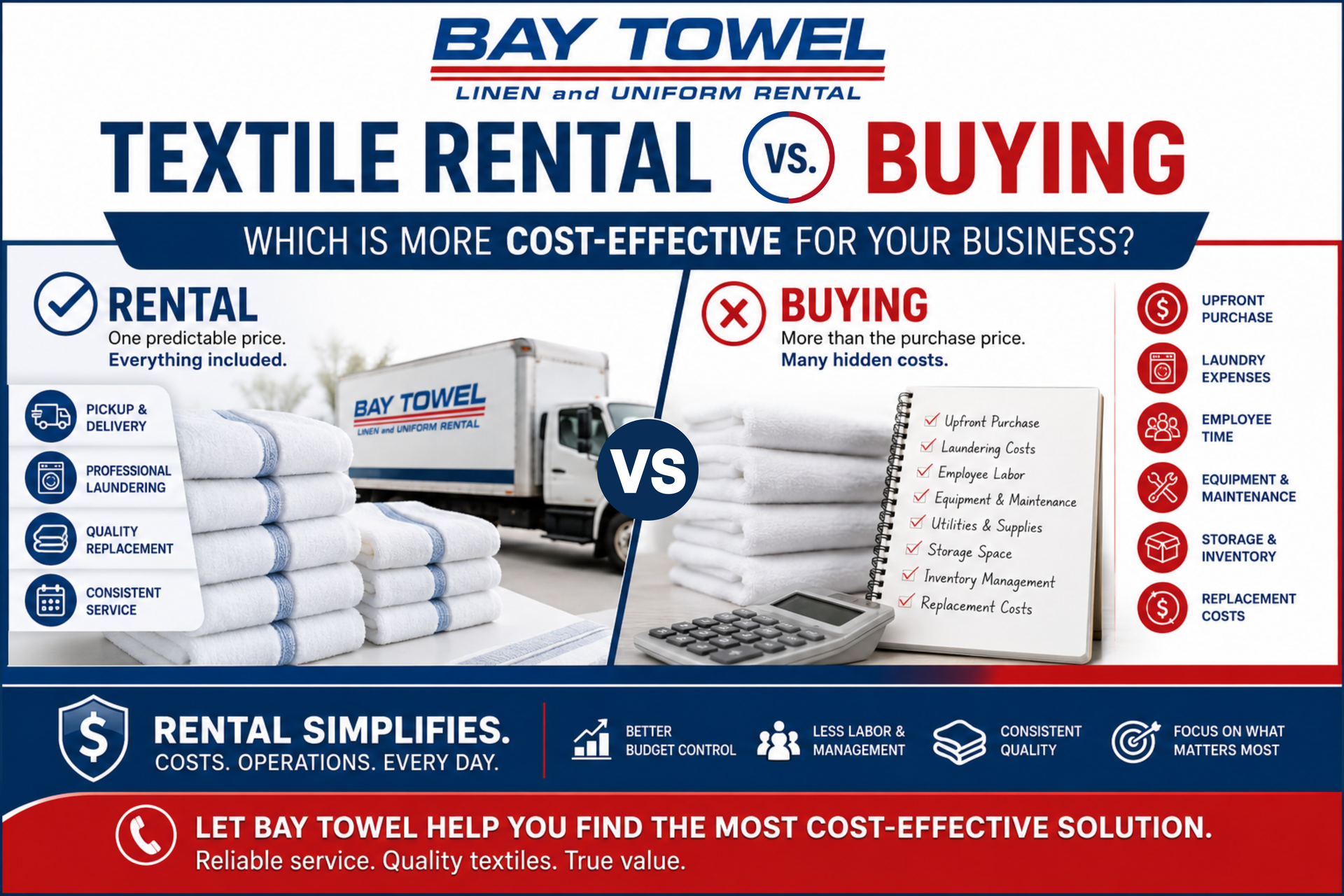
Towels, linens, uniforms, mats, and other reusable textiles may seem like relatively simple business expenses. You buy what you need, wash it, and replace it when it wears out.
But the true cost of owning business textiles goes well beyond the original purchase price.
Businesses also have to consider laundering, labor, utilities, equipment, storage, inventory management, replacement costs, and the time employees spend making sure clean textiles are available when they're needed. Once those expenses are considered, the comparison between buying textiles and using a textile rental service can look very different.
So, which option makes the most financial sense for your business? Let's look at the costs that should be part of the decision.
The Upfront Cost of Purchasing Textiles
Buying gives your business ownership and control over its textile inventory. However, it also means making an upfront investment large enough to keep your operation running between laundry cycles.
For example, a business that uses 100 towels on an average day usually can't simply purchase 100 towels. It needs additional inventory while soiled towels are being washed, clean towels are waiting to be used, and damaged or missing items are being replaced.
The same principle applies to linens, uniforms, mats, and other reusable products.
Businesses may therefore need to purchase significantly more inventory than their daily usage suggests. If the company grows or experiences seasonal demand, another round of purchasing may be necessary.
With a textile rental program, businesses can avoid much of that initial inventory investment. Instead of purchasing the products outright, they pay for an ongoing service designed around their textile needs.
Laundry Costs Add Up Quickly
Once a business owns its textiles, it also needs a plan for keeping them clean.
For businesses handling laundry internally, costs can include:
- Commercial washers and dryers
- Equipment installation and maintenance
- Water and sewer charges
- Electricity or natural gas
- Detergents and other laundry chemicals
- Employee labor
- Space dedicated to laundry operations
- Equipment repairs and eventual replacement
Laundry equipment also has capacity limits. A growing business may eventually need additional machines, more employee hours, or more frequent laundry cycles.
Even when the cost of washing an individual towel or linen seems small, the cumulative cost of processing thousands of textile items over the course of a year can be substantial.
A professional textile rental provider incorporates laundering into the service. Soiled products are picked up, professionally laundered, and clean inventory is returned according to the service schedule.
Don't Forget the Cost of Labor
Labor is one of the easiest expenses to overlook when comparing textile rental with purchasing.
Someone has to collect dirty textiles, operate laundry equipment, transfer loads, dry items, fold or organize clean inventory, restock shelves, and monitor supplies.
Those responsibilities take employees away from other work.
Consider what an hour of employee time actually costs your business after wages, payroll expenses, benefits, and management time are considered. Then multiply that by the number of hours your organization spends handling laundry each week.
For many businesses, the question isn't simply, "Can our employees do the laundry?"
It's "Is doing laundry the best use of our employees' time?"
Replacement Is Part of Textile Ownership
Commercial textiles don't last forever.
Repeated use and laundering eventually cause towels, linens, uniforms, and other products to become worn, stained, torn, or otherwise unsuitable for customer-facing or employee use.
Items can also disappear.
When a business owns its textile inventory, replacing those products becomes another ongoing operating expense. Someone must identify damaged inventory, determine what needs to be reordered, place the order, receive it, and put the replacement products into circulation.
A managed textile rental program can make replacement more predictable by incorporating inventory maintenance into the service arrangement, depending on the products and terms of the program.
That can help businesses maintain consistent textile quality without repeatedly making large replacement purchases.
Storage Has a Cost, Too
Owning textiles requires space.
Businesses need room for clean inventory, soiled textiles awaiting laundry, backup inventory, and sometimes seasonal supplies.
That storage space may be competing with inventory, equipment, production, employee work areas, or other revenue-generating uses.
The cost isn't always obvious because there may not be a separate bill labeled "textile storage." But every square foot of commercial space has value.
A textile rental program can help businesses maintain appropriate inventory levels without keeping excessive quantities of purchased backup stock on-site.
Inventory Management Can Become a Hidden Headache
How many towels do you currently have?
How many are being washed?
How many were damaged this month?
Are you running low on a certain size of garment or type of linen?
Does one location have too much inventory while another doesn't have enough?
For organizations that use large quantities of textiles, managing inventory can become a job of its own.
Without a reliable system, businesses may overbuy to avoid shortages. Others may keep inventory levels too low and discover the problem during a busy shift.
A textile rental service turns much of this process into a managed program. Service levels can be established around the organization's needs, with regular pickups and deliveries helping maintain a dependable supply.
Buying vs. Renting: Compare Total Cost, Not Unit Price
One of the biggest mistakes businesses can make is comparing the purchase price of a textile with the price of textile rental service.
They aren't equivalent costs.
A more useful comparison looks at the total cost of ownership.
If you purchase textiles, consider:
Purchase costs + replacement costs + laundry labor + utilities + chemicals + equipment + maintenance + storage + inventory management
Then compare that figure with the total cost of a textile rental program.
For example, an inexpensive towel may look like the cheaper option when viewed only as a one-time purchase. But that towel could be washed dozens or hundreds of times during its useful life. Every laundry cycle requires resources, and eventually the towel will need to be replaced.
Looking at the complete lifecycle provides a much clearer picture of what your textiles actually cost your business.
When Does Buying Textiles Make Sense?
Purchasing can be a practical option for some organizations.
A business with very low textile usage may find that owning and washing a small inventory is manageable. Businesses that already operate laundry facilities for other reasons may also have the equipment, staff, and capacity necessary to process their textiles efficiently.
Ownership may also appeal to organizations that require highly specialized products or want complete control over purchasing and inventory.
The important point is to include all associated expenses when calculating the cost—not just the initial purchase.
When Does Textile Rental Make Sense?
Textile rental becomes particularly attractive when an organization uses textiles consistently and wants to simplify the work involved in maintaining them.
Businesses may benefit from rental when they:
- Use a high volume of towels, linens, mats, or other textiles
- Spend significant employee time on laundry
- Want to avoid purchasing and maintaining laundry equipment
- Have limited storage or laundry space
- Regularly replace worn or damaged inventory
- Experience changing or seasonal textile demand
- Need reliable, scheduled service
- Want textile expenses to be easier to anticipate and manage
Rental can also provide something that's harder to put into a spreadsheet: convenience.
When employees aren't responsible for washing, drying, folding, purchasing, and tracking textiles, they have more time to focus on the work your business hired them to do.
Questions to Ask Before Making Your Decision
If you're deciding between purchasing and renting, start by calculating what your current textile program really costs.
Ask:
- How much do we spend purchasing textiles each year?
- How much do we spend replacing lost, stained, or worn products?
- How many employee hours per week are devoted to laundry and textile management?
- What do water, energy, detergent, and other laundry supplies cost?
- How much do we spend maintaining laundry equipment?
- How much space do laundry operations and textile storage occupy?
- How often do we experience shortages?
- How much management time goes into ordering and tracking inventory?
Once you have those numbers, you can make a meaningful comparison with a textile rental quote.
Find the Right Textile Solution for Your Business
There's no single answer that's right for every organization. For businesses with minimal textile needs, purchasing may be simple and cost-effective. But as textile volume increases, the hidden costs of ownership can increase with it.
That's why it's important to compare more than the price of the product itself.
Labor, laundering, utilities, equipment, storage, inventory management, and replacement all contribute to the true cost of owning textiles.
A professionally managed textile rental program can combine many of those responsibilities into one ongoing service, helping your organization simplify operations while maintaining a dependable supply of clean products.
If you're wondering whether textile rental could be more cost-effective for your organization, Bay Towel can help you evaluate your needs and compare your options.
Contact Bay Towel today to learn more about a textile rental program built around your business.